5 Pinterest Myths That Are Quietly Killing Your Growth
Pinterest advice online is full of leftover rules from a decade ago — habits that made sense back when the platform looked completely different, and that quietly hold people back today. If your Pinterest account has felt stuck for months despite you "doing everything right," there's a decent chance one of these five myths is the actual reason, not a lack of effort or a bad niche.
The frustrating part is that most of these myths sound reasonable on the surface, which is exactly why they've survived so long. Let's go through them one at a time.
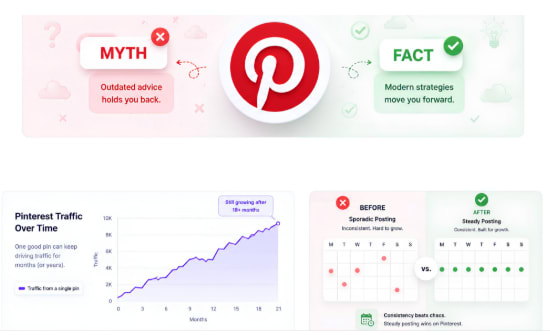
Myth 1: "Pinterest Is Just for Recipes and Home Decor"
This one's outdated, and it's costing entire industries real traffic. Yes, food and home content perform well on Pinterest — but so do B2B tools, SaaS products, finance tips, career advice, fitness plans, travel itineraries, and small business services. Pinterest functions less like a social feed and more like a visual search engine, and people search it for almost everything they'd normally type into Google.
If your niche doesn't feel like a "Pinterest niche," that's usually a sign nobody's competing for your keywords there yet — which is an opportunity, not a wall. A financial planner pinning simple budgeting graphics, or a software company pinning a clean workflow infographic, is often working with far less competition than the millionth banana bread recipe.
Myth 2: "You Need to Post Multiple Times a Day to Grow"
This is probably the single most exhausting myth on this list, and it's the one that burns people out fastest. Pinterest doesn't reward volume for its own sake — it rewards steady, predictable posting over time. Dumping fifteen pins in one afternoon and going quiet for two weeks tends to perform worse than spacing those same fifteen pins evenly across the month.
The instinct to post constantly usually comes from confusing Pinterest with faster-moving platforms like Instagram or X, where content disappears from view within hours. Pinterest simply doesn't work that way, which brings us to the next myth.
Myth 3: "Pinterest Content Dies Fast, Just Like Everywhere Else"
Here's the one most people genuinely don't realize: a pin published today can still be actively driving traffic six, twelve, even eighteen months from now. Because Pinterest works as a search engine rather than a chronological feed, a well-optimized pin doesn't "expire" the way a tweet or an Instagram post effectively does after a day or two.
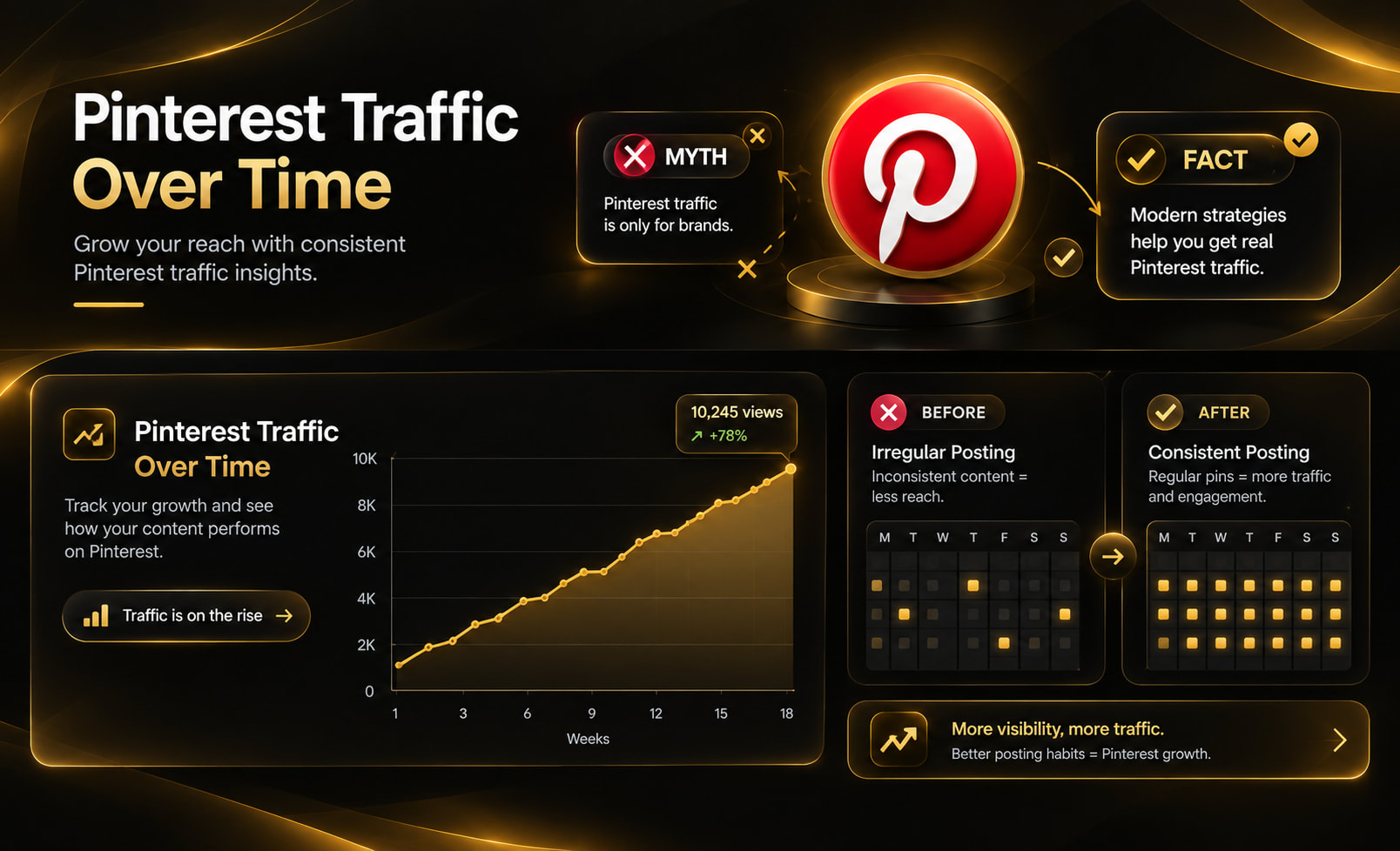
This changes how you should think about your time. A single pin, done well — clear image, a specific keyword-rich title, a description that actually explains what's behind the click — can keep paying off long after you've moved on to other content. Chasing constant novelty is far less valuable here than it is almost anywhere else online.
It also means old content deserves a second look before you assume it needs replacing. A pin that performed poorly in its first week isn't necessarily a failure — sometimes it just hasn't been discovered yet, and a slightly better title or a fresh image pointing to the same content can be enough to give it a second life months later.
Myth 4: "Follower Count Is What Actually Matters"
Follower count feels like the obvious scoreboard, but on Pinterest it's a weak signal at best. Because Pinterest is search-driven, an account with a few hundred followers can regularly out-reach an account with tens of thousands, simply because its pins are better optimized for what people are actually searching.
The metrics worth actually watching are impressions, saves, and outbound clicks — not follower count. Optimizing purely for followers usually means chasing vanity numbers while the metrics that actually translate into traffic or sales quietly stay flat. If you have to pick one number to check weekly, outbound clicks is usually the closest thing Pinterest has to a bottom line — it's the number that most directly reflects people actually leaving Pinterest to visit whatever you're promoting.
Myth 5: "Scheduling Tools Make Your Account Look Fake or Hurt Your Reach"
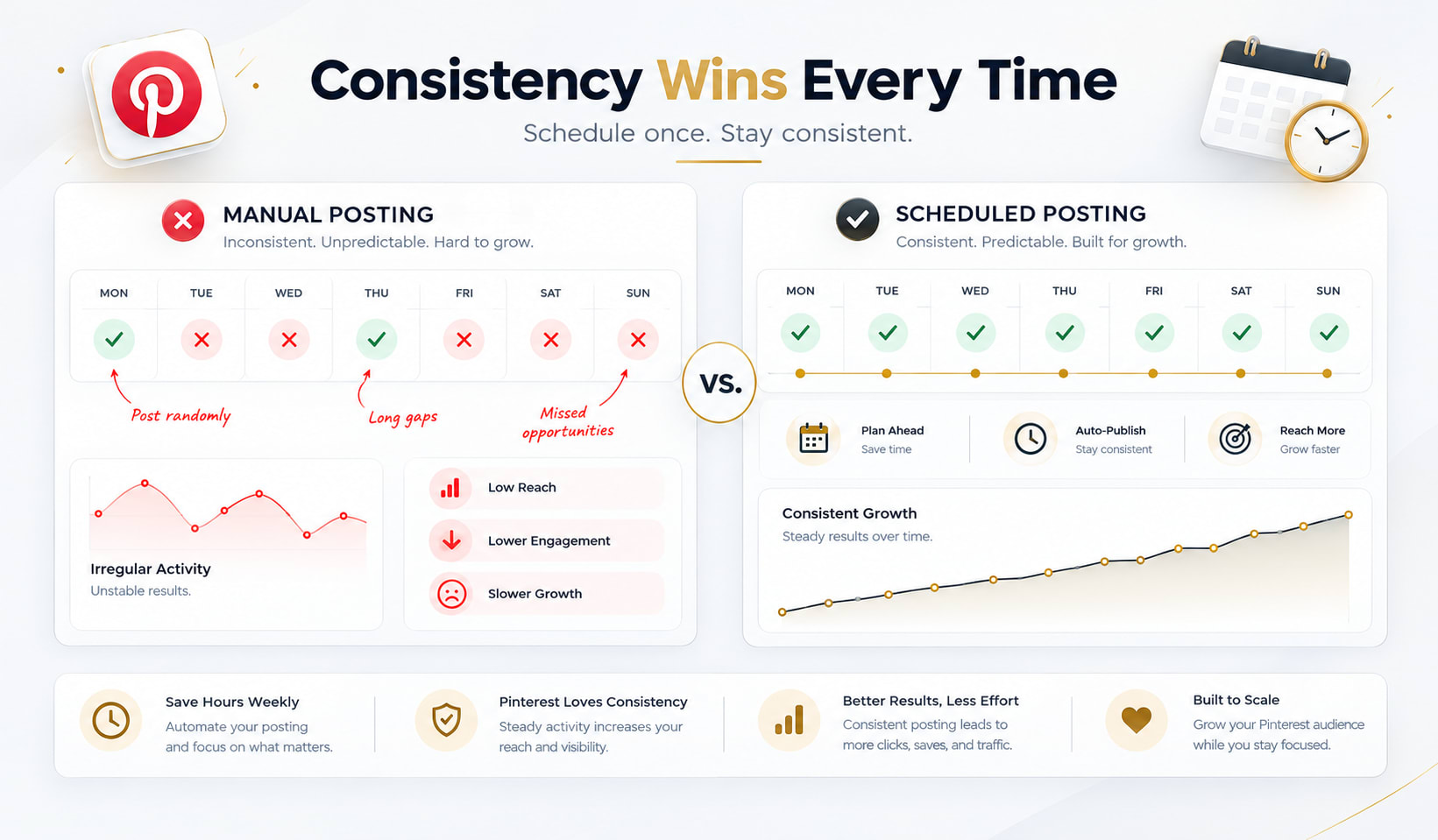
This myth holds a lot of people back from the one change that would actually help them the most: consistency. There's a lingering belief that Pinterest can tell the difference between a pin posted manually and one posted through a scheduler, and that automation somehow gets penalized.
It doesn't work that way. What Pinterest actually responds to is the pattern of posting itself — steady and spaced out, versus erratic and bursty — not whether a human clicked "publish" at that exact second. A scheduler that keeps your posting rhythm steady, even during the weeks you don't have time to log in daily, generally helps far more than it hurts. The account that quietly posts three times a week, every week, tends to outperform the one that posts erratically no matter how "authentic" that erratic posting feels.
If you've been avoiding automation because you assumed it would hurt you, it's worth testing that assumption instead of just accepting it. It's currently free to try, so there's no real cost to finding out for yourself — check the pricing details if you want the specifics.
What Actually Moves the Needle
Strip away these five myths, and Pinterest growth gets a lot simpler than most advice makes it sound: post steadily rather than constantly, treat each pin like it needs to work for months rather than hours, watch impressions and saves instead of followers, and don't be afraid of tools that help you stay consistent when life gets busy.
None of that requires a niche that "fits" Pinterest, a huge following, or hours of daily attention — just a rhythm you can actually keep up with. The accounts that quietly grow month over month are rarely the ones doing the most; they're usually just the ones that stopped believing they had to.
If you want to dig into more of the mechanics behind scheduling and consistency, our scheduling guides cover the practical side in more depth, and the full tools library has more free resources worth a look while you're there.
Batching your content shouldn't require compromising on quality. Sofriq Publish is an advanced social media management system that lets you handle your entire cross-platform strategy effortlessly, combining professional bulk scheduling with instant 1-click AI post generation to give you your week back.
Join the Conversation
Share your perspective, ask thoughtful questions, or leave constructive feedback about this article.