Reclaim Your Week: What Automating Pinterest Actually Gives You Back
Ask most business owners how much time Pinterest takes each week, and they'll guess low. Then they actually time themselves for a week, and the number is almost always bigger than expected — not because any single task takes long, but because the small stuff adds up in ways nobody bothers to track. It's rarely one big block of wasted time; it's fifteen small interruptions that never get added up honestly.
Here's what that time actually looks like when you break it down, and what changes once it's handed off to a scheduler instead of your daily to-do list.
What Manual Posting Actually Costs, Minute by Minute
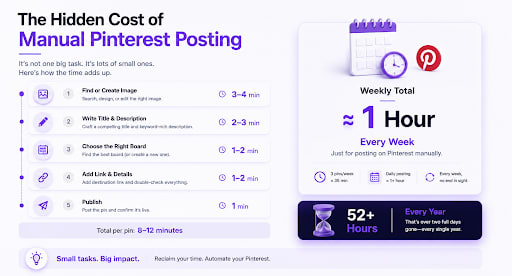
A single pin, done properly, isn't a thirty-second task. Finding or creating the image takes a few minutes. Writing a title and description that isn't generic takes a few more. Picking the right board, double-checking the destination link, and actually publishing adds a few minutes on top of that. None of these steps feels heavy in isolation — which is exactly why the total is so easy to underestimate.
Add it up honestly: roughly eight to twelve minutes per pin is a realistic average once you include the small context-switching that happens every time you open the app, remember what you were going to post, and get back into it. Post three times a week, and that's thirty to thirty-five minutes. Post daily, and it climbs past an hour — every single week, indefinitely, with no natural endpoint.
The Real Cost Isn't the Minutes — It's the Interruptions
The bigger cost rarely shows up in a simple minute count. It's the mental tax of remembering to do it in the first place — the nagging thought mid-afternoon that you still haven't posted today, the context-switch away from whatever you were actually focused on, the small guilt that builds up on the days you forget entirely. That interruption cost doesn't show up on a timesheet, but it's very real, and it's often worse than the actual time spent.
Compare that to a single planning session where you decide a month's worth of content in one sitting, and the difference isn't just about total hours — it's about how many separate times per week your brain has to context-switch back to "don't forget to post."
What a Batch Session Actually Looks Like
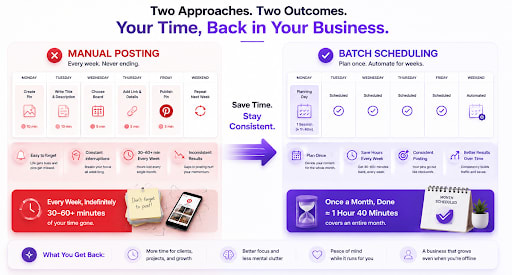
Automating doesn't mean the work disappears — it means the work gets compressed into one sitting instead of scattered across the week. A realistic batch session: an hour to prepare a month's worth of images, thirty minutes to write titles and descriptions for each one, and ten minutes to load everything into a social media scheduler with your dates and frequency set.
That's roughly an hour and forty minutes, once, covering an entire month. Compare that to the thirty-to-sixty-plus minutes every single week that manual posting demands, and the math isn't close. A month of manual posting adds up to two to four hours minimum; the batched, automated version covers the same month in well under two hours, done once, with nothing left to remember for the next four weeks.
What You Actually Get Back
The honest way to think about this isn't "I saved two hours." It's "I got an entire month of Tuesday afternoons back to spend on something that actually needed my attention." That might be client work, content you're better at creating than scheduling, or genuinely just not thinking about Pinterest until it's time for the next month's batch.
There's also a quieter benefit that doesn't show up in any time calculation: consistency stops depending on how busy or tired you are in a given week. A sick day, a hectic client deadline, or a vacation no longer means a gap in your posting — the schedule you built weeks ago just keeps running exactly as planned, whether or not you're anywhere near a computer.
Where This Cost Multiplies
This time cost isn't uniform across everyone using Pinterest. A solo creator posting three times a week feels it as a mild, manageable drag. An agency managing Pinterest for five or six clients feels it as a genuinely significant chunk of the week — the same thirty-to-sixty minutes per account, multiplied across every account, every single week, with no batching to soften it. For anyone in that position, the math above isn't a minor convenience; it's the difference between Pinterest management being a sustainable service to offer clients or a quiet source of burnout on the team delivering it.
This Isn't About Doing Less — It's About Deciding Once
The instinct to resist automation often comes from a worry that it means being less hands-on, less careful, less involved in your own marketing. In practice, it's closer to the opposite. You spend the same — sometimes more — thoughtful attention on titles, images, and strategy, just concentrated into one focused session instead of spread thin across daily five-minute interruptions that make it hard to think clearly about any of it.
Deciding a month's worth of content once, with real focus, tends to produce better results than deciding it in a rush, thirty times, in between everything else you're trying to do that day.
Getting Your Time Back
Writing unique titles and descriptions for a massive bulk upload can cause burnout. That’s where Sofriq Publish steps in. As a comprehensive social media management platform, it features a 1-click AI post copy generator designed specifically for professional batch scheduling across all your social channels.
Our scheduling guides walk through exactly how to structure that first batch session if you want a starting point.
Join the Conversation
Share your perspective, ask thoughtful questions, or leave constructive feedback about this article.